Trying on multiple hats physically can be time-consuming and unhygienic. Customers often struggle to visualize how a hat will look on them, leading to hesitation and abandoned online shopping carts. Retailers face high return rates and missed sales opportunities because customers cannot experience the product before purchasing.
Augmented Reality (AR) offers a perfect solution by enabling virtual try-ons through smartphone cameras or webcams. This technology superimposes digital hat models onto the user's head in real-time, allowing them to see how different styles, colors, and sizes look from every angle. It bridges the gap between online shopping and the physical store experience, making hat buying more interactive and confident.
This guide will explain how AR technology works for virtual hat fittings and how you can implement it for your hat business, whether you are a retailer or a manufacturer like us looking to offer enhanced services to your clients.
What is AR Technology in Hat Retail?
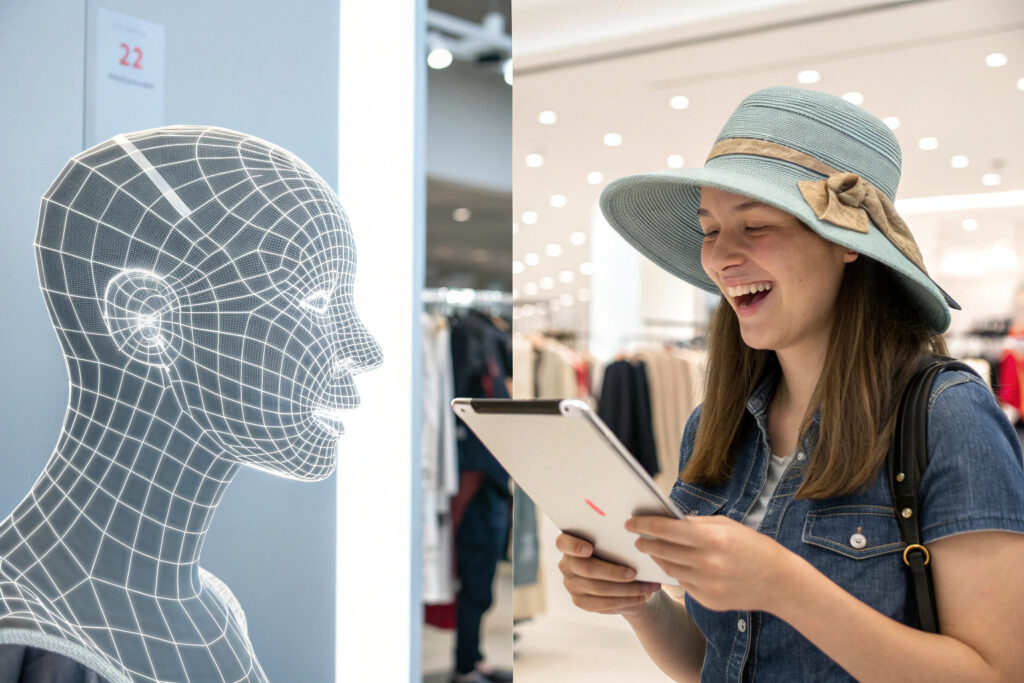
Augmented Reality in hat retail is a technology that uses a device's camera to capture the user's head and then places a realistic 3D model of a hat onto their image in real-time. Unlike Virtual Reality (VR), which creates a completely digital environment, AR enhances the real world by adding digital elements to it. For hats, this means customers can see themselves wearing any hat from your collection without physically touching it. The core technology involves face and head tracking to ensure the hat moves naturally with the user, adjusting for tilt, rotation, and scale. This provides an immersive and accurate try-on experience that can significantly boost customer engagement and reduce product returns.
How Does AR Create a Realistic Try-On Experience?
AR creates a realistic try-on by using advanced computer vision and machine learning algorithms. First, the software maps key points on the user's face and head to understand its shape and orientation. Then, it renders a high-fidelity 3D model of the hat, which is meticulously created to reflect the real product's materials, textures, and proportions. The software adjusts the hat's size and perspective in real-time to match the user's movements, ensuring it doesn't look like a static image pasted on. Lighting and shadows are also simulated to blend the digital hat seamlessly with the user's real-world environment, creating a convincing and realistic preview. This level of detail is crucial for customer confidence in their online purchase.
What Hardware is Needed for Virtual Fittings?
The beauty of modern AR for virtual hat fittings is its accessibility. For the end customer, no special hardware is needed. They can use the device they already own:
- Smartphones and Tablets: Most iOS and Android devices with a front-facing camera are capable. Apps can be downloaded or experiences can run directly in a web browser.
- Laptops and Desktops: A standard webcam is sufficient for a try-on experience through a website.
For businesses like ours at shanghaifumaoclothing, creating the AR experience requires investment in 3D modeling software and AR development platforms, but the end-user barrier to entry is delightfully low, enabling widespread adoption.
Why Should Your Hat Business Invest in AR?
Investing in AR is no longer a gimmick; it's a strategic business decision with a clear return on investment. For hat retailers and manufacturers, it directly addresses major pain points in the e-commerce journey. The primary benefit is a significant reduction in return rates, as customers make more confident and accurate purchasing decisions. Furthermore, AR dramatically increases engagement time on your website or app. A fun and interactive try-on experience is more likely to be shared on social media, providing free marketing and expanding your brand's reach. It ultimately translates to higher conversion rates and a stronger, more modern brand identity.

Can AR Really Reduce Product Returns?
Yes, absolutely. A primary reason for returns in fashion e-commerce is "product not as expected," which includes issues with fit, size, and style. AR virtual fittings directly combat this by giving customers a much better understanding of how the hat will look on them. They can judge the proportions, style suitability, and color against their own skin tone and outfit. This leads to more informed purchases and fewer surprises upon delivery. Implementing AR can lead to a substantial reduction in return rates, which saves money on reverse logistics and restocking, directly improving your bottom line. This makes it a powerful tool for e-commerce optimization.
How Does AR Improve Customer Engagement?
AR transforms passive browsing into an active and memorable experience. Instead of just scrolling through static images, customers can play with different hats, share photos and videos of their virtual try-ons with friends, and spend more time interacting with your brand. This increased "dwell time" is a positive signal to search engines and builds a deeper emotional connection with the product. The fun, interactive nature of AR encourages social sharing, turning your customers into brand advocates. This heightened level of engagement is proven to increase conversion rates and foster brand loyalty.
How to Implement AR for Your Hat Collection?
Implementing AR for your hat collection is a structured process that can be scaled to fit your business size. It begins with the digital creation of your products and ends with integration into your sales channels. The key steps involve creating accurate 3D models of your hats, choosing the right AR platform or developer, and embedding the experience into your website or app. For manufacturers, offering AR capabilities can be a value-added service for your wholesale clients, helping them sell more effectively and strengthening your partnerships.
What is the Process for Creating 3D Hat Models?
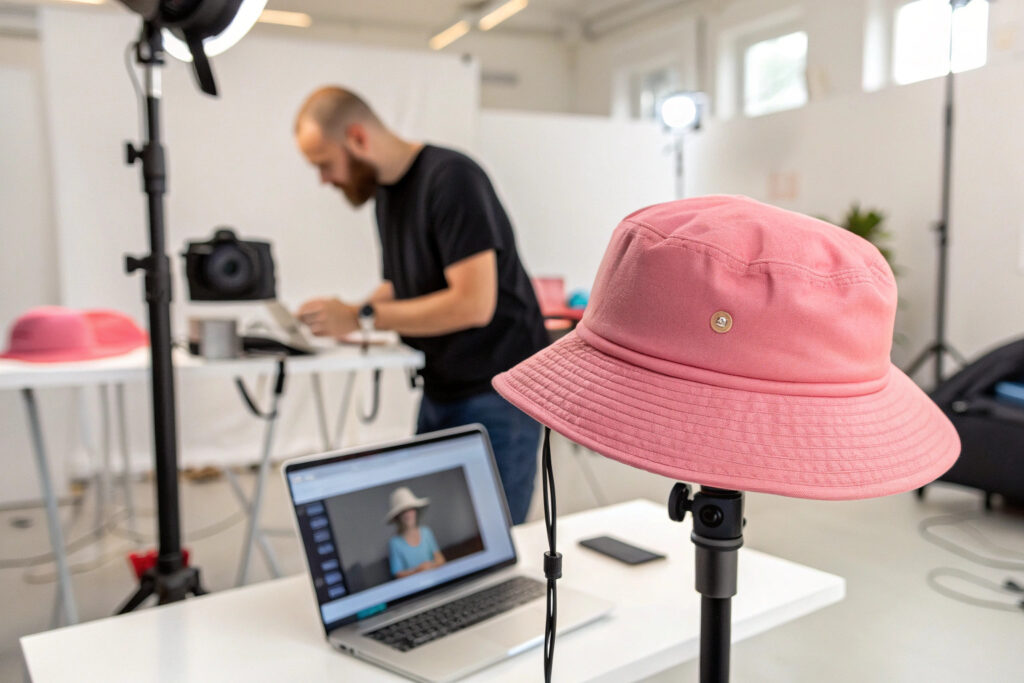
The first and most crucial step is creating high-quality 3D models of your hats. This process typically involves:
- 3D Scanning or Photogrammetry: Using specialized scanners or taking hundreds of photographs of a physical hat sample from all angles to capture its precise geometry and texture.
- Digital Modeling and Texturing: 3D artists use software like Blender or Maya to refine the model, ensuring it is the correct size and shape. They then apply high-resolution textures and materials to mimic the real fabric, whether it's woven straw, textured wool, or shiny leather.
- Optimization: The model is optimized for real-time rendering on mobile devices and websites without sacrificing visual quality. These accurate models are not just for AR; they can also be used for product visualization on your product pages, creating 360-degree spin views.
How to Integrate AR into an E-commerce Platform?
Once you have your 3D models, you need to make them interactive. There are several ways to do this:
- AR SDKs: Using Software Development Kits (SDKs) like Apple's ARKit or Google's ARCore to build a custom try-on feature within your mobile app.
- WebAR Platforms: Utilizing web-based AR services that allow customers to access the try-on experience directly through their mobile browser without needing to download an app. This is often the best option for reaching the widest audience quickly.
- Plugins for Existing Platforms: Many e-commerce platforms like Shopify have apps and plugins that can facilitate AR integration. For a seamless experience, the virtual try-on button should be placed prominently on the product page, making it easy for customers to access. As a manufacturer, we at shanghaifumaoclothing can support our partners by providing these ready-to-use 3D models for their platforms.
What Are the Challenges of AR Hat Fittings?
While powerful, AR try-on technology is not without its challenges. Awareness and adoption are still growing, so some customers may need to be encouraged to use the feature. The initial setup cost and technical requirement for creating high-quality 3D content can be a barrier for smaller businesses. Furthermore, the technology must continuously improve to handle diverse hair styles, head shapes, and accessories like glasses with perfect accuracy. Acknowledging and planning for these challenges is key to a successful implementation.

Is the Technology Accurate for All Head Shapes?
Current AR technology has become very sophisticated but may not be perfect for every single edge case. The algorithms are trained on vast datasets of facial features, but extreme hairstyles (like very large afros or updos) and headwear like religious coverings can sometimes challenge the tracking. The key is to manage customer expectations. Providing clear instructions and using a disclaimer that the virtual try-on is a "simulation for style purposes" can help. The technology is continuously learning and improving, and for the vast majority of users, it provides an accurate and reliable representation of fit and style, which is a massive step up from a static product image.
What Are the Cost and Adoption Barriers?
The main barriers are development cost and user adoption. Creating photo-realistic 3D models and developing a smooth AR experience requires an initial investment in software and skilled 3D artists and developers. However, the cost of this technology has decreased significantly, and the ROI from reduced returns often justifies the investment. To overcome adoption barriers, the AR experience must be incredibly easy to find and use. A simple "Try It On" button that launches the experience instantly, with no complex instructions, is essential. Promoting the feature through marketing campaigns can also drive initial usage and demonstrate its value to customers.
Conclusion
Augmented Reality is revolutionizing the way customers shop for hats online. It solves the critical problem of visualization, leading to more confident purchases, fewer returns, and a more engaging brand experience. While implementing AR requires an initial investment in 3D modeling and platform integration, the long-term benefits for sales and customer satisfaction are substantial. The technology is accessible, with most consumers already owning the necessary hardware in their pockets.
If you are a retailer or buyer looking to enhance your hat sales with cutting-edge AR technology, partner with a manufacturer that understands the digital future. We can provide the high-quality 3D models and support needed to make your virtual try-on initiative a success. For more information on how we can collaborate, please contact our Business Director, Elaine, at elaine@fumaoclothing.com.