Successfully negotiating a DDP (Delivered Duty Paid) agreement to Europe can transform your business. It turns you from a simple supplier into a strategic, reliable partner for your European buyers. While it involves more responsibility, mastering DDP can be your ultimate competitive advantage in a market that values predictability, quality, and hassle-free service. The key lies in meticulous preparation, transparent communication, and partnering with the right experts to navigate the European Union’s regulatory landscape.
DDP, or Delivered Duty Paid, is an Incoterm where the seller bears all costs and risks until the goods are delivered to the buyer’s specified location in the destination country, including paying import duties and taxes. Negotiating favorable DDP terms for European shipments requires a deep understanding of this responsibility, precise cost calculation, strategic legal framing, and adapting your approach to diverse European business cultures. For a hat manufacturer like us at Shanghai Fumaoclothing, this means mastering everything from fabric-specific tariff codes to the nuanced preferences of a German versus a French buyer.
Many suppliers fear DDP due to its complexity and risk. However, this very complexity is what creates a formidable barrier to entry for your competitors. By systematically building expertise in European logistics, customs, and compliance, you can offer a seamless “door-to-door” experience that European buyers increasingly demand. This guide will walk you through the four pillars of successful DDP negotiation with Europe, turning a potential challenge into your most powerful tool for securing long-term, profitable partnerships.
How Do You Calculate DDP Costs Accurately for Europe?
The foundation of any successful DDP negotiation is an airtight, transparent cost calculation. Under-quoting can erase your profits, while over-quoting can lose you the order. The goal is to build a comprehensive and defendable price that covers every expense from your factory floor to the buyer's European warehouse.
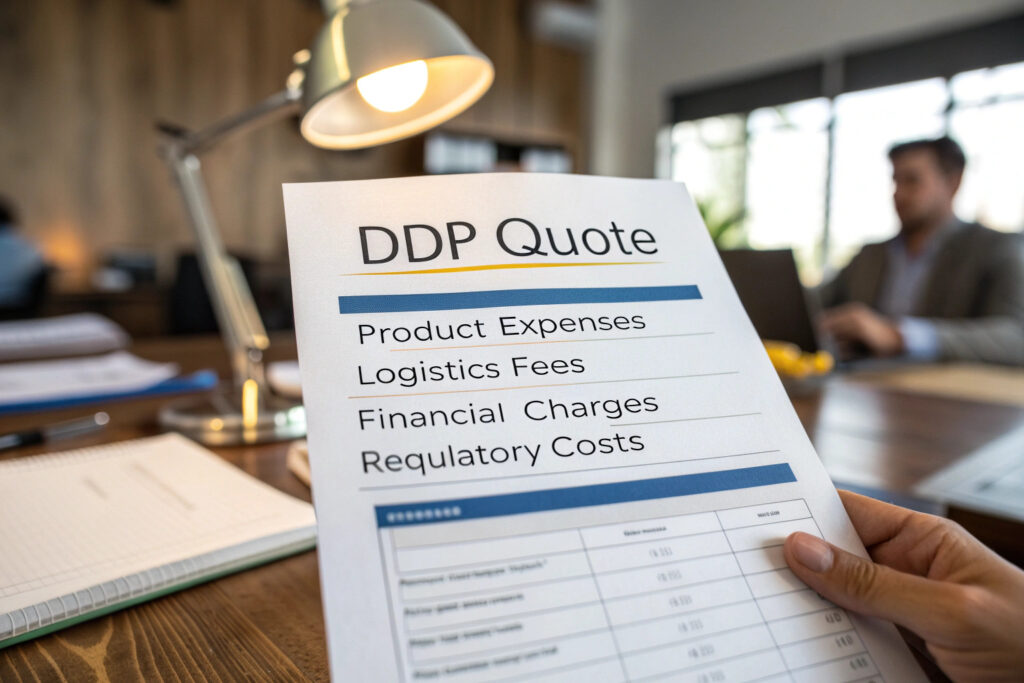
A DDP quote is far more than your product cost plus an estimated shipping fee. It is the sum of all logistical, financial, and regulatory steps in the supply chain. The most volatile and often misunderstood elements for Europe are Import Duties and Value-Added Tax (VAT). These are not flat rates but are determined by the specific Harmonized System (HS) code of your product.
Why Are HS Codes The Most Critical Factor?
For hats, accurate HS code classification is non-negotiable. The HS code dictates the duty rate and is essential for smooth customs clearance. Hats generally fall under Chapter 65 of the HS system. However, a knitted beanie (6505), a felt fedora (6504), and a safety helmet (separate classification) all have different codes and duty rates. Misclassification can lead to customs delays, fines, or incorrect duty payments, for which you, as the DDP seller, are solely liable. To get it right, you must consider the hat's material (e.g., polyester, cotton, felt), construction (knitted, sewn), and purpose. Using tools from the World Customs Organization (WCO) or consulting with a specialized freight forwarder is crucial. For example, a UK ruling for a polyester hat clearly shows its classification under 6505 00 90, demonstrating the granular level of detail required.
What Hidden Costs Must You Account For?
Beyond the obvious freight and duty costs, several “hidden” items can impact your margin. First, European VAT is a significant cost. Unlike a simple percentage in some countries, EU VAT must be calculated on the aggregate value of the goods, freight, insurance, and duty. Second, consider Last-Mile Delivery within Europe; trucking from Rotterdam port to a warehouse in inland Germany costs differently than delivery to a major city like Paris. Third, always include a Risk Buffer (e.g., 3-5%) for currency fluctuation, potential customs inspections (which incur extra fees), and unexpected port demurrage charges. Presenting a cost breakdown table to your buyer builds immense trust and justifies your price.Learn more Shanghai Fumaoclothing ditails page.
How Should You Structure the DDP Contract to Manage Risk?
A well-structured contract is your legal shield in a DDP agreement. It clearly defines responsibilities, allocates risks, and provides mechanisms to handle unforeseen events. The goal is to avoid ambiguity, which is the root of most international trade disputes.
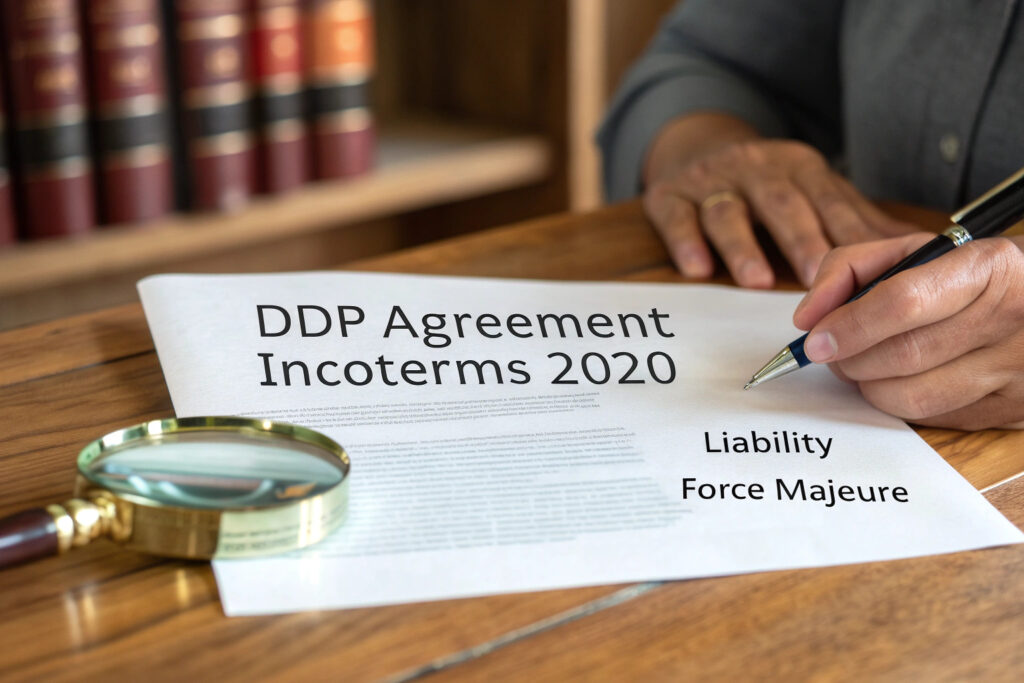
Your contract must explicitly state that the agreed Incoterm is “Delivered Duty Paid (DDP) [Named Place of Destination], Incoterms® 2020.” This single reference incorporates a globally recognized set of rules from the International Chamber of Commerce (ICC), establishing a baseline for liability. However, you must go beyond the standard Incoterms and add specific clauses to protect your business.
What Key Protective Clauses Are Non-Negotiable?
Price Adjustment Clause: This is critical. It allows for renegotiation if external costs rise beyond your control. For example: *“If official import duty rates, VAT rates, or freight carrier surcharges increase by more than 5% between the contract date and the shipment date, the seller reserves the right to adjust the DDP price accordingly, upon providing official evidence of the increase. This protects you from unforeseen regulatory changes.
Liability and Risk Delineation: The contract must specify the exact moment risk transfers from you to the buyer (typically upon unloading at the named destination). Crucially, state that your liability is limited to the CIF value of the goods (Cost, Insurance, and Freight) unless additional insurance is purchased. Exclude liability for consequential losses (like the buyer’s lost sales).
Force Majeure Clause: Define events that excuse delay, such as severe port congestion, strikes, or government-imposed trade restrictions. Given recent global volatility, a robust force majeure clause is essential.
Who Handles Compliance, and What If Things Go Wrong?
As the DDP seller, you are responsible for export and import compliance. The contract should affirm this but also specify that you will act through appointed, licensed agents (your freight forwarder and their EU customs broker). Include a clause that the buyer must provide any necessary data (like their EU EORI number) to facilitate clearance.
For dispute resolution, specify arbitration in a neutral forum like the Singapore International Arbitration Centre (SIAC) rather than litigation in either party’s home courts. Arbitration is generally faster, more confidential, and its awards are widely enforceable globally.
What Are the Key Logistics & Partner Considerations for DDP to Europe?
You cannot execute DDP alone. Your choice of logistics partner determines whether the process is smooth and profitable or a nightmare of delays and extra costs. The right partner acts as an extension of your team on the ground in Europe.
The core challenge of DDP is managing the import clearance process in a foreign country where you lack a legal entity. Many European countries have regulations that can complicate DDP for a non-resident seller. For instance, some may require a local fiscal representative for VAT affairs. A proficient freight forwarder with a strong EU network will navigate these hurdles for you.

What Makes a Freight Forwarder the Right Partner for European DDP?
Look for a forwarder with demonstrable EU-specific expertise. They must have:
- A Strong EU Network: Own offices or trusted partner agents in the key destination countries.
- Customs Brokerage Capability: In-house or tightly integrated customs clearance services within the EU.
- Digital Transparency: A platform that provides real-time tracking, document management, and clear cost breakdowns. As highlighted by industry experts, digital solutions can drastically reduce delays.
- Experience with Your Product Category: Knowledge of how to correctly classify and declare hats, understanding relevant standards or labeling requirements.
How Do You Plan for the "Last Mile" in Europe?
The “last mile”—final delivery from the EU port of entry to the buyer’s door—is a key cost and service factor. Discuss with your forwarder:
- Delivery Speed vs. Cost: Air freight DDP is faster but far more expensive than sea freight.
- Consolidation Options: For smaller orders, Less than Container Load (LCL) consolidation can be cost-effective.
- Warehousing: If the buyer is not ready to receive, you may need to arrange and pay for short-term storage in Europe—a cost that must be anticipated.
How Do European Business Customs Influence DDP Negotiations?
European buyers are not a monolith. A successful negotiation requires an understanding of regional business cultures. Your ability to adapt your DDP proposal to these cultural preferences can be as important as the price itself.
For example, a buyer in Germany will expect a highly detailed, precise DDP cost breakdown, aligned with their preference for thorough planning and quality. They will respect a well-structured, transparent proposal. A buyer in France may place high value on the aesthetics and packaging of the goods, and appreciate a proposal that acknowledges these elements. Understanding these nuances helps you frame your DDP offer as a tailored service, not a one-size-fits-all solution.

What Are Common European Preferences You Should Leverage?
- Demand for Certainty: European buyers, particularly large retailers or brands, highly value predictable landed costs and on-time delivery. DDP offers them exactly that. Emphasize the predictability and hassle-free nature of your DDP service.
- Focus on Quality and Compliance: European markets have stringent standards. Highlight how your DDP service includes rigorous quality control and ensures full compliance with EU regulations (like REACH for chemicals), which adds tremendous value beyond just shipping.
- Payment Terms: Be aware that European buyers often prefer simpler payment terms like TT (Telegraphic Transfer) or DP (Documents Against Payment) over complex Letters of Credit (LC). Your DDP proposal should align with these preferences.
How Do You Communicate the DDP Value Proposition?
Frame the DDP agreement as a partnership. Communicate clearly: “We manage the complex logistics and customs, so you can focus on your core business of selling and marketing.” This shifts the discussion from pure cost to shared value. For savvy partners like Shanghai Fumaoclothing, it positions us as a solution provider, not just a factory.
Conclusion
Negotiating DDP terms for European hat shipments is a strategic process that demands expertise in logistics, finance, law, and cultural intelligence. It involves moving beyond simple price discussions to building a comprehensive, risk-managed service package. By mastering accurate cost calculation with precise HS codes, drafting protective and clear contracts, selecting a logistics partner with deep European expertise, and tailoring your approach to the specific European buyer, you can turn the complexity of DDP into your strongest competitive edge.
This approach does more than win a single order; it builds the foundation for a long-term, resilient partnership where you are seen as an indispensable extension of your client’s supply chain.
Ready to offer your European buyers a seamless, reliable DDP experience? Partner with a supplier that has the expertise and infrastructure to make it work flawlessly. Contact our Business Director, Elaine, at elaine@fumaoclothing.com to discuss how we can develop and deliver your hat orders to Europe under optimized DDP terms.