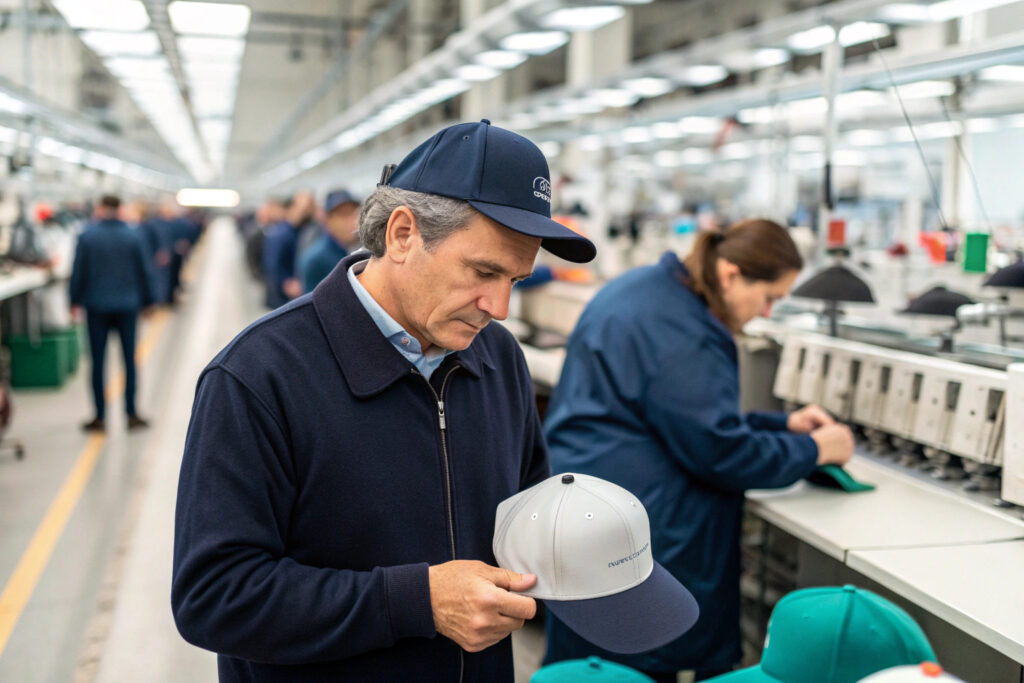
As someone who has been in the hat manufacturing business for over 20 years, I've seen it all. I've met countless buyers like Ron from the U.S., confident and sharp, who know what they want but are tired of the runaround. They're frustrated with surprise tariffs, missed deadlines, and quality that doesn't match the samples. Finding a reliable supplier feels like searching for a needle in a haystack, a process filled with risks that can sink a business before it even starts.
The key to identifying a qualified hat supplier is to look beyond the price tag and evaluate their end-to-end capabilities, including verified quality control systems, proven R&D expertise, and transparent logistics. A truly great partner doesn’t just sell you hats; they invest in your success by offering a seamless, reliable, and innovative production experience. At my company, Shanghai Fumao Clothing, we've built our reputation on being that partner.
I get it. You're under pressure to deliver great products to your customers while keeping costs down. The global supply chain is a minefield of potential problems. But what if you could find a partner who anticipates these problems? A supplier who has the experience to navigate customs, the technology to guarantee quality, and the scale to offer competitive pricing without sacrificing service? It's not a fantasy. Let's walk through exactly how you can find a supplier who will become the backbone of your business, not a source of constant headaches.
What are the signs of a reliable supplier?
You're scrolling through Alibaba or walking a massive trade show floor. Every booth looks promising, and every salesperson tells you they're the best. It's overwhelming. You're worried about making the wrong choice, getting stuck with a supplier who talks a big game but can't deliver on quality or deadlines. This uncertainty costs you time and money, and the stress is immense.
A reliable supplier shows clear signs of legitimacy and expertise, primarily through internationally recognized certifications, a transparent and verifiable track record, and a professional, responsive communication style. These aren't just nice-to-haves; they are essential indicators that you're dealing with a serious, capable partner who values quality and client satisfaction as much as you do.
When I first started, I learned the hard way that a low price often hides major problems. One of my early mistakes was partnering with a factory that offered an unbelievably low price on a large order of beanies. The samples looked great, but the bulk production was a disaster—inconsistent sizing, poor stitching, and the colorfastness was terrible. That experience taught me to dig deeper. Now, I tell every potential client to look for the evidence. Don't just take a supplier's word for it; ask for proof. A great supplier will be proud to show you their certifications and connect you with long-term clients.

How do you verify their quality control?
A supplier promises "high quality," but what does that actually mean? Without a concrete way to verify their claims, you're essentially gambling with your inventory. You might receive a shipment of bucket hats where the stitching is uneven or the fabric feels cheap, leaving you with unsellable products and a major financial loss. This is a common fear for buyers, and it's a valid one.
The best way to verify quality control is to demand proof of a robust, documented system. Ask if they have an in-house testing lab and, more importantly, if it's accredited by a recognized body like CNAS (China National Accreditation Service for Conformity Assessment). At Global-Caps, our CNAS-accredited lab isn't just for show; it's where we test every batch for things like colorfastness, shrinkage, and material composition. We even use a QR code tracking system so our clients can see the test data for their specific order in real-time. Also, inquire about their inspection process. A reliable factory will have multiple inspection points: for raw materials, during production (in-line), and a final inspection before shipping. Don't be afraid to ask for their standard AQL (Acceptable Quality Limit) levels, which are governed by standards from organizations like the American Society for Quality (ASQ).
What certifications should you look for?
Navigating the world of certifications can be confusing. You see acronyms like ISO, BSCI, and OEKO-TEX, but you're not sure which ones are critical for your business. You worry that if you choose a supplier without the right certifications, your products could be rejected by major retailers or fail to meet the legal and ethical standards of your target market, especially in the EU and US.
The specific certifications you need depend on your product and market, but some are universally important. ISO 9001 is a must-have, as it demonstrates a commitment to a quality management system. For social compliance, look for audits like BSCI (Business Social Compliance Initiative) or Sedex, which ensure ethical working conditions. This is non-negotiable for us. If you're focusing on eco-friendly products, ask for certifications like GRS (Global Recycled Standard) for recycled materials or OEKO-TEX for textile safety. We've invested heavily in green production, and our recycled polyester and organic cotton lines are fully certified, which has been a huge driver for our European clients.
How to assess development and production capacity?
You have a brilliant idea for a new line of hats. You need a supplier who can not only produce it but also help you develop it, turning your vision into a tangible product. The problem is, many factories are just order-takers. They lack the R&D muscle to innovate and the production agility to meet your timelines. You're stuck with slow sample development and long lead times, causing you to miss key selling seasons.
To assess a supplier's capacity, evaluate their R&D team's expertise, their sample development speed, and their stated bulk production lead times, then verify these claims by asking for case studies or references. A powerful supplier has a dedicated R&D department that understands trends and materials, not just a single technician. They should be able to create a sample from a tech pack in about a week, not a month.
I remember working with a startup brand that wanted to launch a line of performance sun hats with UV protection and moisture-wicking fabric. Their previous supplier took six weeks just to source the material. They came to us, and our R&D team, which includes over 20 textile experts, had a finished, lab-tested sample in their hands in eight days. That's the difference an innovative partner makes. We analyze market trends with AI tools and have strong local partnerships with fabric mills, which allows us to move incredibly fast. This agility is a core part of our service at Shanghai Fumao Clothing.

How fast should sample development be?
You've sent your tech pack to a potential supplier, and now you're waiting. And waiting. Slow sample development is a major red flag. It signals an inefficient process and can cause you to miss your launch window. If it takes them a month to make a single sample, how long will it take to produce 10,000 units? This delay creates a bottleneck that stifles your brand's growth and agility.
In today's fast-paced fashion market, a one-week turnaround for sample development should be the standard for a top-tier supplier. This speed indicates they have an experienced R&D team and strong relationships with material suppliers. For example, our location in Keqiao, the heart of China's textile industry, gives us direct access to over 800+ seasonal fabrics. This allows us to source materials and create prototypes for everything from a complex fascinator to a technical balaclava with incredible speed. When you're vetting a supplier, give them a test. Send a tech pack and see how long it takes. Their performance here will tell you a lot about their overall efficiency.
How do you gauge their real production volume?
A supplier's website might claim they can produce millions of units, but how can you be sure they have the capacity for your bulk order without sacrificing quality? You're worried about placing a large order only to find out they've outsourced it to a smaller, unvetted factory, leading to inconsistent quality and a loss of control. This is a common and risky practice in the industry.
To gauge real production volume, ask for specifics. Inquire about the number of production lines, key machinery (like embroidery and sewing machines), and the number of workers. A transparent supplier will have no problem sharing this. Another great strategy is to ask about their largest single order to date. This gives you a concrete idea of what they can handle. At Global-Caps, we are part of the world's largest hat manufacturing cluster, which collectively handles nearly 25% of global hat production. This ecosystem gives us incredible flexibility and scalability. We can handle small-batch orders for startups and massive orders for giants like Walmart or H&M with the same level of quality control and efficiency.
You've finally found a supplier with great quality and a decent price. You breathe a sigh of relief, but then the hidden costs start piling up. Unexpected shipping fees, confusing customs paperwork, and, worst of all, crippling tariffs. Suddenly, your profitable order is barely breaking even. You feel blindsided and frustrated, realizing that the initial price was just a lure.
A truly qualified supplier provides transparent, all-in pricing and has a dedicated logistics team to manage the entire process, from factory floor to your warehouse, mitigating risks like tariffs and shipping delays. They should be able to give you a clear quote that includes shipping, insurance, and customs clearance. Don't settle for a simple FOB (Free On Board) price; ask for a DDP (Delivered Duty Paid) quote to avoid surprises.
This is a huge pain point for our American clients like Ron. The tariffs on Chinese goods can be a deal-breaker. However, as an experienced exporter, we have developed strategies to manage these costs effectively. We leverage our deep understanding of HS codes (Harmonized System) and can sometimes structure shipments through regions that are not as heavily impacted. Furthermore, our home base in Keqiao is a major logistics hub with "Silk Road Keqiao" initiatives that streamline customs and provide access to overseas warehousing. This infrastructure is a massive competitive advantage that we pass on to our clients.

How can you avoid unexpected tariff costs?
The fear of sudden tariffs can make sourcing from China feel like a gamble, especially for U.S. buyers. You read headlines about trade wars and new duties, and you worry that a 25% tariff could suddenly be slapped on your order, completely destroying your profit margins. This uncertainty makes it difficult to plan your finances and set your retail prices.
While no one can completely eliminate tariff risk, an experienced supplier can help you mitigate it. A knowledgeable partner stays on top of international trade policies and can offer advice. For instance, slight modifications to a product's material composition or design can sometimes change its HS code to one with a lower tariff rate. We work with our clients on this. Additionally, diversifying your manufacturing base is a long-term strategy. While our core is in China, our network within the broader RCEP (Regional Comprehensive Economic Partnership) zone provides future flexibility. A good supplier should be a strategic partner who helps you navigate these geopolitical challenges, not just a factory that ships your goods and hopes for the best. This is a level of service that distinguishes a commodity seller from a true supply chain partner.
What payment and shipping terms are secure?
You're about to wire a 30% deposit to a new supplier overseas. It's a significant amount of money, and you can't help but feel a little nervous. What if the supplier disappears? What if the final product is terrible and you've already paid? These financial risks are a major source of anxiety for importers.
Secure payment terms are crucial for building trust. A common and fair arrangement is a 30% deposit to start production and the remaining 70% balance payment after the goods have passed a final inspection but before they are shipped. For larger, ongoing relationships, a Letter of Credit (L/C) issued by a bank provides security for both parties. At our company, we are flexible and work with clients to find a solution that feels secure for them. We have strong partnerships with major banks, ensuring our financial stability and the ability to handle large orders without cash flow interruptions. For shipping, always clarify the Incoterms. While FOB is common, asking for CIF (Cost, Insurance, and Freight) or DDP can provide you with more cost certainty and less logistical hassle.
Why is a digital-first approach important?
In today's world, you expect to be able to track your pizza delivery in real-time, so why should tracking a multi-thousand-dollar order be a black box? You send an email to your supplier asking for an update and have to wait 24 hours for a vague reply. You want to see their latest fabric options but have to wait for them to mail a physical catalog. This slow, analog process is inefficient and out of step with modern business.
A digital-first supplier uses technology to provide transparency, convenience, and speed, offering tools like live inventory access, virtual showrooms, and real-time order tracking. This approach shows they are invested in the client experience and are operating a modern, efficient business. It saves you time, reduces miscommunication, and gives you the control you need to manage your business effectively.
From the beginning, I knew we had to be more than just a factory. We had to be a technology-enabled solutions provider. That's why we invested in a digital infrastructure that allows our clients to log in and see our live inventory of over 800 fabric designs. They can walk through our virtual showroom from their office in New York or Los Angeles. As mentioned, our QR code system provides instant access to quality control data. This digital convenience is no longer a luxury; it's a necessity for any serious player in the global e-commerce landscape. It’s about providing the same level of service and transparency that you would expect from a domestic partner, even if we are an ocean away. This commitment to technology is a core reason why brands like ZARA and other fast-fashion giants appreciate partners who can keep up with their pace.

What digital tools should a top supplier offer?
You're juggling multiple orders and need information now, but your supplier's process is stuck in the past. To check on your order status, you have to email a specific sales rep and hope they're in the office. To review new designs, you have to schedule a video call across inconvenient time zones. This lack of direct access is a major drag on your productivity.
A top supplier should offer a suite of digital tools that empower you. This includes a client portal for real-time order tracking, a digital fabric library or virtual showroom to browse materials and designs 24/7, and collaborative design platforms where you can comment on tech packs and samples directly. We've found that these tools dramatically reduce communication errors and speed up the entire pre-production process. For instance, instead of emailing back and forth about a color, a client can just drop a pin on a virtual lab dip and say, "Make it 5% more saturated here." This level of precision and convenience is what modern B2B (Business-to-Business) relationships should look like.
How does technology ensure transparency?
"Trust me" is not a business strategy. You need verifiable proof that the product you ordered is the product being made. Without technological transparency, you are flying blind, hoping that the factory is using the specified recycled polyester or that the antibacterial treatment was actually applied. This lack of visibility is a significant risk, especially when dealing with functional or eco-friendly products.
Technology is the ultimate tool for building trust through transparency. Our QR code tracking system is a perfect example. A client can scan a code on their product's tag and instantly see the CNAS lab report detailing its composition, performance tests, and eco-certifications. This is radical transparency. It proves that the recycled polyester is GRS-certified or that the organic cotton meets EU eco-standards. This digital paper trail provides the accountability that brands need to confidently make claims to their own customers. It transforms the supplier relationship from one based on hope to one based on verifiable data. This is the future of sourcing, and we at Shanghai Fumao Clothing are proud to be leading the way.
Conclusion
Finding the right hat supplier is one of the most critical decisions you'll make for your brand. It's not about finding the cheapest price; it's about finding a true partner. A qualified supplier is one who demonstrates unwavering reliability through verified quality control and certifications. They possess the R&D and production capacity to bring your ideas to life quickly and at scale. They navigate the complexities of global logistics and hidden costs with transparency. And finally, they embrace a digital-first approach that gives you the convenience, control, and transparency you need to run a modern business. By focusing on these four key areas, you can move beyond the frustrating cycle of sourcing and build a lasting, profitable partnership.
If you're tired of the uncertainty and are looking for a supplier who co-creates value, I invite you to reach out. Let's discuss how we can build your next great hat collection together. You can contact me directly to start the conversation. My name is Elaine, Business Director at Global-Caps, and my email is: elaine@fumaoclothing.com.