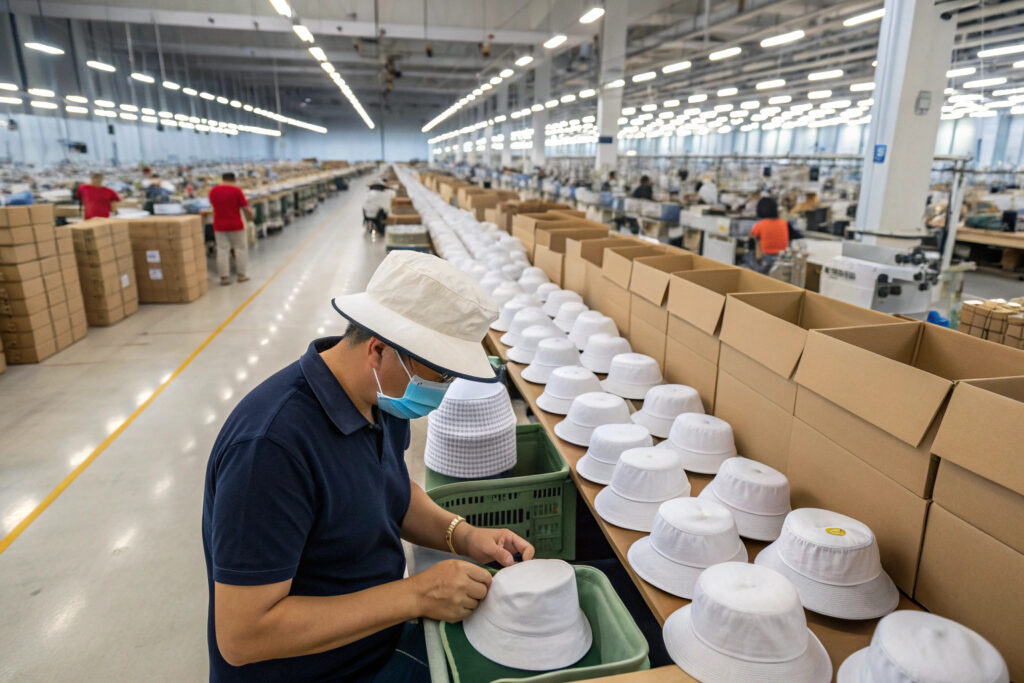
As a wholesale client for a major music festival or a large retail chain, you're not just buying a product; you're securing a critical piece of your event's merchandise strategy. You need tens of thousands of bucket hats delivered on time, with consistent quality, and perfectly branded. You've probably had nightmares about a shipment arriving late, the colors being wrong, or the quality being so poor that it reflects badly on your festival's brand. The stakes are incredibly high.
To successfully fulfill large-scale bucket hat orders for festival clients, a manufacturer must execute a meticulous, multi-stage strategy that covers: 1) Scalable Pre-Production Planning, 2) Robust Supply Chain Management for raw materials, 3) A Streamlined, High-Volume Production Workflow, and 4) Rigorous, multi-point Quality Control and Logistics. This isn't just about sewing hats; it's about industrial-scale project management where every detail is planned and verified.
At my company, Shanghai Fumao Clothing, we've been the engine behind massive merchandise rollouts for over two decades. Fulfilling an order for 50,000 bucket hats for a festival client is a completely different universe than making a few hundred for a boutique. It requires a factory infrastructure, a battle-tested process, and a level of transparency that gives the client total confidence. Let's pull back the curtain on how a professional manufacturer reliably delivers on these high-stakes orders.
How Do You Plan for a 50,000-Unit Order? (Pre-Production)
The success or failure of a large-scale order is determined long before the first sewing machine is switched on. The pre-production phase is the most critical, as it's where we build the blueprint for the entire project. Rushing this stage is the single biggest mistake a client or manufacturer can make.
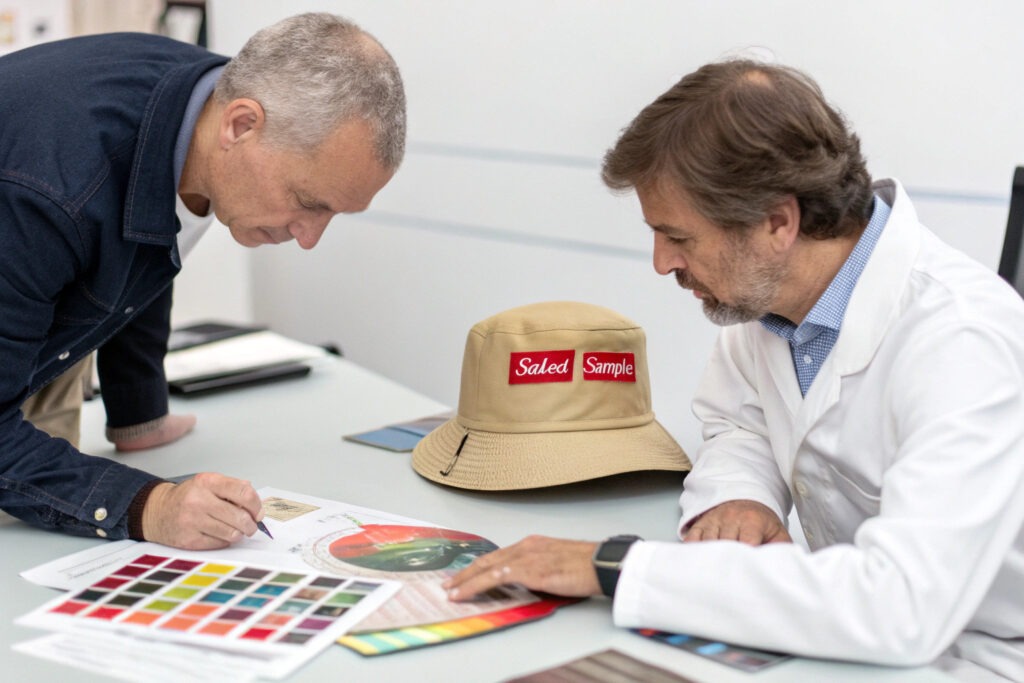
This phase is all about locking down every single variable and creating a perfect, approved "Golden Sample." This sample is not just a prototype; it is the physical contract and the benchmark against which every single one of the 50,000 hats will be measured. The process involves finalizing the tech pack, approving lab dips for color, and stress-testing the final sample.
What Is a "Lab Dip" and Why Is It Non-Negotiable?
For a festival client, color is everything. The hat's color must perfectly match the festival's branding. A "lab dip" is a small swatch of the actual production fabric dyed to the client's specified Pantone color. We will produce several versions (e.g., slightly lighter, slightly darker) and send them to the client for approval under different lighting conditions (daylight, office light). Only when the client signs off on a specific lab dip do we purchase the thousands of yards of fabric. This step prevents the catastrophic error of 50,000 hats showing up in the wrong shade of blue.
What Is the Role of the "Golden Sample"?
Once the tech pack is finalized and the lab dip is approved, we create a perfect final sample—the "Golden Sample." This hat is constructed with the actual bulk fabric, thread, and branding. The client will test this sample for fit, feel, and construction quality. Once they approve it, we "seal" it. We keep one, the client keeps one. This becomes our bible. Our quality control team on the factory floor will use this exact hat as the physical benchmark to check the production units against. It eliminates any ambiguity or "he said, she said" issues down the line.
How Do You Source Materials for a Massive Order? (Supply Chain)
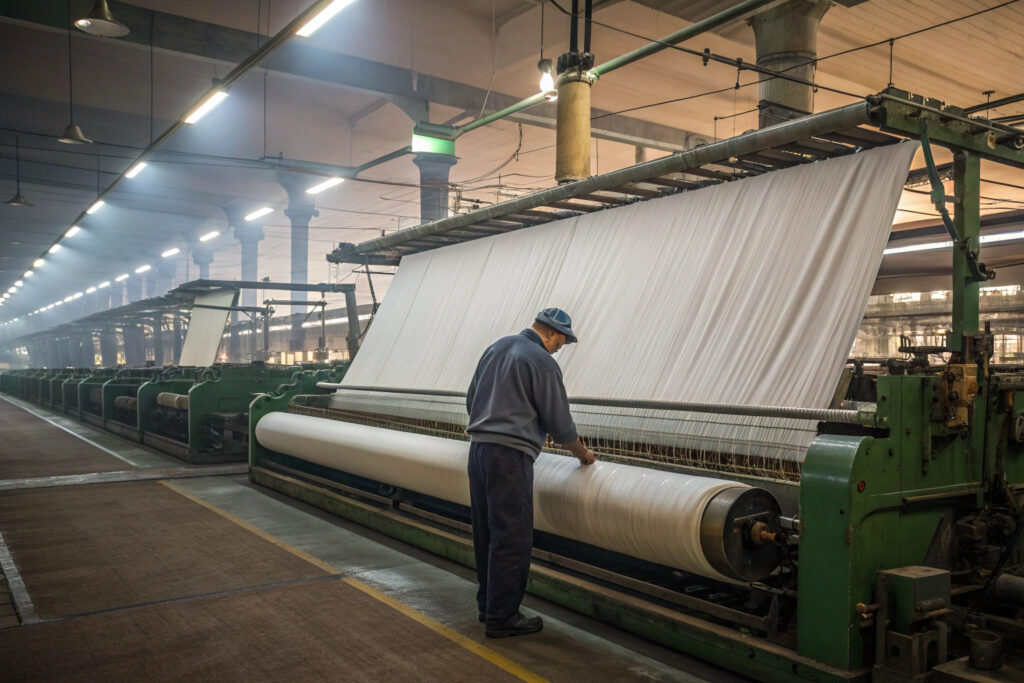
You can't make 50,000 hats without a mountain of raw materials. For an order of this size, we can't just walk into a fabric market. We need to work directly with textile mills to secure the entire production run of fabric, thread, and accessories.
A robust supply chain strategy involves booking production capacity at the mill in advance and ordering all materials from a single dye lot. This ensures absolute consistency across the entire order and mitigates the risk of delays caused by material shortages.
Why Is a Single Dye Lot Crucial?
Even with precise lab dip matching, there can be minute color variations between different batches of dye (dye lots). For a 50,000-unit order, if you use fabric from multiple dye lots, you risk having hats with slightly different shades of the same color, which looks unprofessional. By ordering the entire quantity of fabric at once, we ensure it is all colored in a single, massive dye lot at the mill. This guarantees that hat #1 and hat #50,000 are identical in color.
How Do You Manage the Timeline for Materials?
This is a project management challenge. We work backward from the client's delivery date. If the hats need to be in Los Angeles by July 1st, and ocean freight takes 4 weeks, and production takes 4 weeks, then all raw materials must be in our factory by early May. This means we need to have placed the fabric order with the mill in March. A professional manufacturer will provide the client with a detailed "Critical Path" calendar that outlines every single milestone, from lab dip approval to the final shipping date.
How Do You Manufacture 50,000 Hats Efficiently? (Production Workflow)
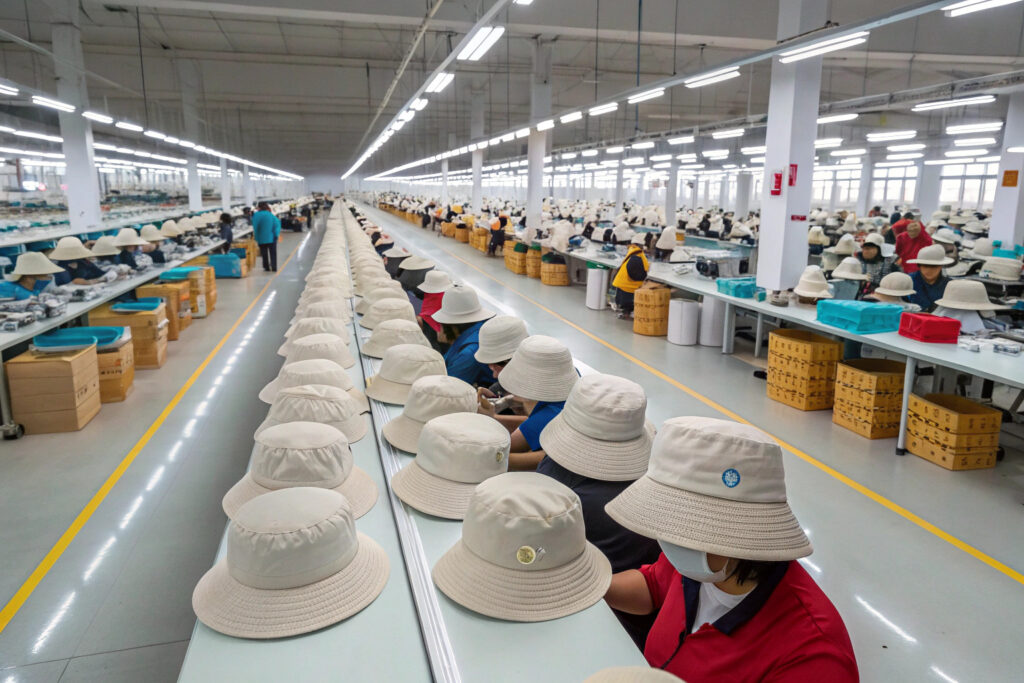
Once the materials arrive, the factory transforms into a highly organized assembly line. Fulfilling a large order is not about having one person make a hat from start to finish; it's about breaking the process down into dozens of small, specialized steps.
A streamlined production workflow involves setting up dedicated production lines where each worker is an expert at a single task—one person only cuts fabric, another only sews brims, another only attaches sweatbands. This specialization dramatically increases speed, efficiency, and, most importantly, consistency.
How Is Cutting Done at Scale?
For a large order, we don't cut fabric with scissors. The approved fabric is laid down in a stack of hundreds of layers. We then use an automated, computer-guided cutting machine or a high-powered industrial die-cutter. This ensures that every single panel for all 50,000 hats is cut with perfect precision and consistency, which is impossible to achieve with manual cutting.
What Does the Assembly Line Look Like?
A typical bucket hat line might have 20-30 stations. It works like this:
- Panel Sewing: A worker sews the side panels together to form the crown.
- Brim Construction: Another worker stitches the multiple rows of the brim.
- Crown & Brim Joining: A specialist joins the finished crown to the finished brim.
- Sweatband Attachment: The next person attaches the inner sweatband.
- Branding: If there's an embroidered logo, this is often done on the panels before they are sewn together. If it's a woven label, it's attached at a specific station.
This division of labor, a core principle of lean manufacturing, is the only way to produce high volume while maintaining high quality.
How Do You Ensure Quality Across the Entire Order? (QC and Logistics)
Quality control (QC) on a large order isn't something you do at the end; it's a continuous process that happens at every single stage. A final inspection is too late to fix a systemic problem.
Our QC strategy involves in-line inspectors who check the work at key points on the assembly line, and a final AQL inspection before the goods are packed. This multi-layered approach catches errors early and guarantees the final shipment meets the client's standards.
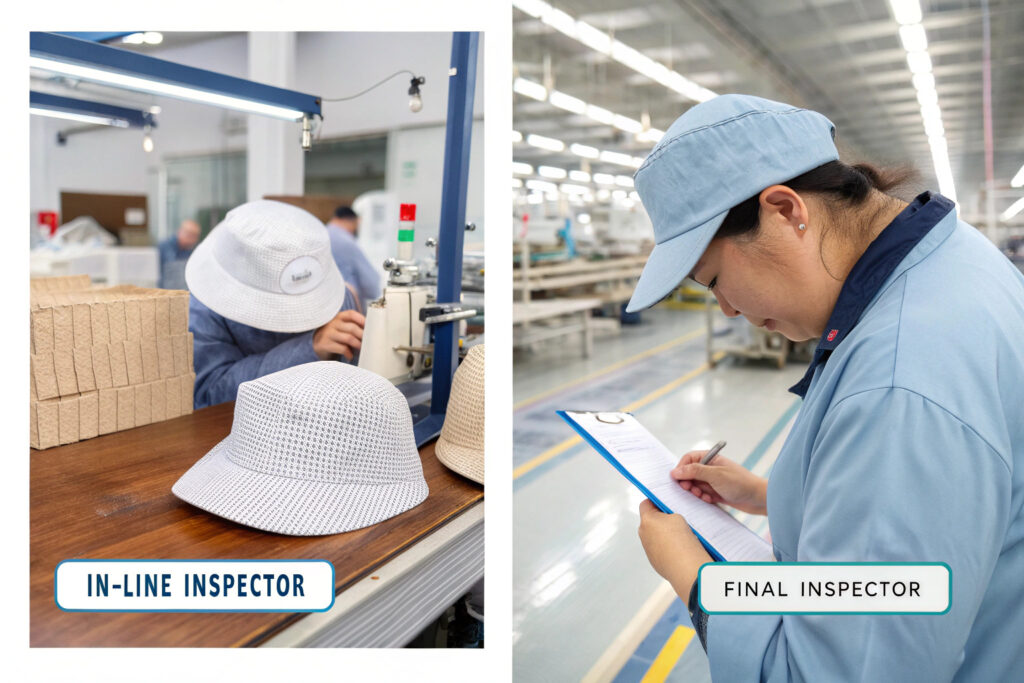
What Is an "In-Line" vs. "Final" Inspection?
In-line inspectors are stationed on the production floor. For example, after the brim is joined to the crown, an inspector will check a random sample to ensure the seam is strong and straight. If they find a problem, they can stop that station immediately and fix the issue before thousands of defective hats are made. The final inspection happens after the hats are finished and cleaned. A dedicated QC team inspects a statistically significant portion of the order based on an AQL (Acceptable Quality Limit) standard agreed upon with the client. They check for everything from cosmetic flaws to correct packaging.
How Are the Hats Packed and Shipped?
For a festival client, packaging and logistics are critical. The hats are typically packed in a specific way to make distribution at the event as easy as possible. For example, a client might request that hats be packed in inner cartons of 50 and master cartons of 200, all clearly labeled with the style, color, and quantity. We handle all the logistics, from booking the shipping containers to managing customs clearance, ensuring the goods arrive at the client's designated warehouse or distribution center on the agreed-upon date.
Conclusion
Fulfilling a large-scale bucket hat order for a festival client is a complex, high-stakes operation that demands military-grade precision. It's a science of scale. Success hinges on a meticulous pre-production process to perfect the "Golden Sample," a robust supply chain to secure materials, a highly efficient and specialized production line, and a relentless, multi-stage quality control system. By mastering these four pillars, a professional manufacturer can transform a client's creative vision into tens of thousands of flawless products, delivered on time and on budget, ensuring the festival's brand shines as brightly as its stage lights.
If you are a wholesale client with a large-scale order and need a manufacturing partner with a proven track record of delivering under pressure, my team is built for the challenge. Please contact our Business Director, Elaine, at elaine@fumaoclothing.com to discuss your volume production needs.