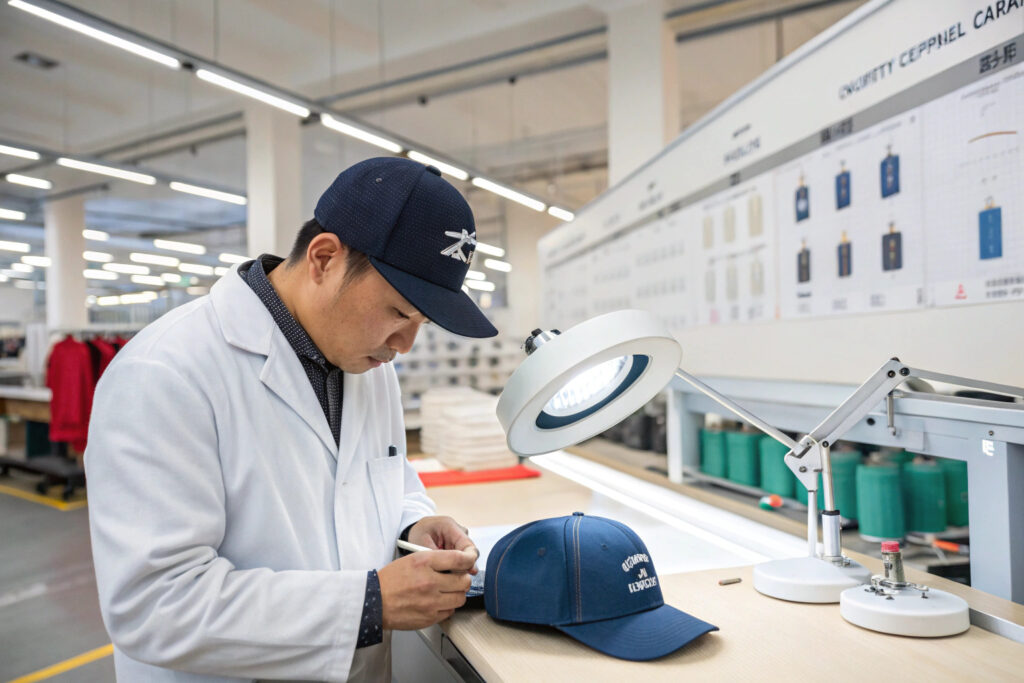
As a Western buyer sourcing hats from China, you're likely navigating a world of incredible opportunity mixed with a healthy dose of apprehension. You've heard the stories—the amazing cost-effectiveness on one hand, and the horror stories of inconsistent quality, missed deadlines, and products that don't match the sample on the other. You're probably asking yourself: how can I be sure that my order of 20,000 hats will meet the same standard as the perfect sample I approved?
The quality control standards for reputable hat manufacturing in China are based on a multi-layered, internationally recognized system, primarily the AQL (Acceptable Quality Limit) framework. This isn't a vague promise of "good quality"; it's a rigorous, data-driven process that involves: 1) Strict Raw Material Inspection (IQC), 2) Continuous In-Process Quality Control (IPQC) at every production stage, and 3) A statistically significant Final Quality Control (FQC) inspection before shipment. A professional factory doesn't just check for quality at the end; they build it into the entire manufacturing process.
My name is Ron, and as the owner of shanghai Fumao Clothing, I've spent over two decades navigating and defining these very standards from within the heart of China's textile industry. I can tell you that the difference between a top-tier factory and a low-cost workshop lies entirely in their commitment to a robust QC system. A professional manufacturer welcomes scrutiny and operates with transparency. We understand that your brand's reputation is literally in our hands. Let's pull back the curtain and walk through the specific, tangible QC standards you should demand from any Chinese hat manufacturer.
Incoming Quality Control (IQC) – The Foundation?
You cannot build a great house on a weak foundation. In hat manufacturing, the raw materials are the foundation. The first and arguably most important QC stage happens the moment the rolls of fabric, spools of thread, and boxes of buckles arrive at the factory. This is called Incoming Quality Control (IQC).
The goal of IQC is to catch any material defects before they enter the production line. Finding out that a roll of fabric has color inconsistencies after you've already cut 5,000 hat panels is a catastrophic and costly failure. A professional factory will have a dedicated IQC team that inspects all incoming materials against the approved standards set during the pre-production sampling phase.
How Is Fabric Inspected?
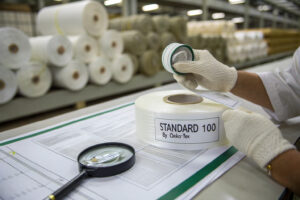
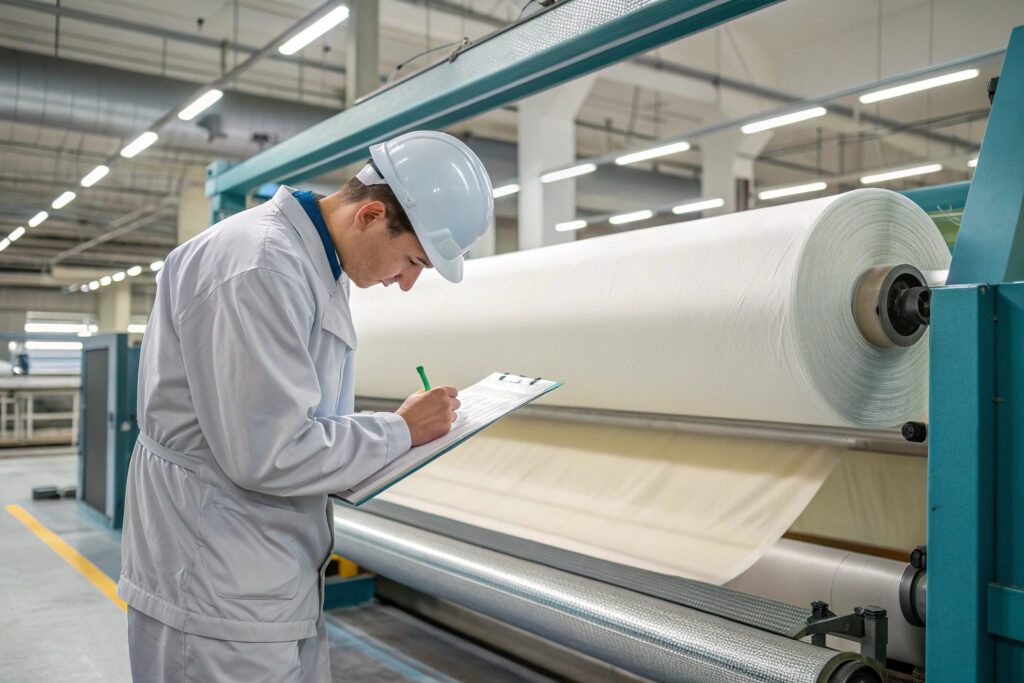
Fabric is the main component, and it undergoes the most scrutiny. The IQC team will randomly select a percentage of rolls from the shipment (e.g., 10%) and perform a series of checks:
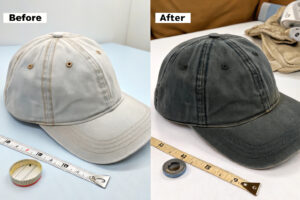
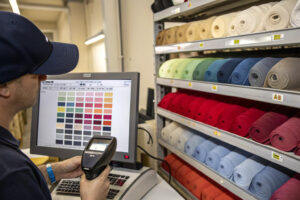
- Color Matching: The fabric color is compared against the approved lab dip under a standardized light source (a D65 light box) to ensure it's a perfect match.
- Defect Inspection: A section of the fabric is unrolled over a light table to check for any weaving flaws, holes, stains, or color streaks.
- Weight and Hand-Feel: The fabric's weight (measured in Grams per Square Meter or GSM) is checked to ensure it matches the specification. The inspector also checks the "hand-feel" against the approved sample.
What About Accessories and Thread?
Every single component is checked.
- Thread: The color is matched, and the strength is tested.
- Buckles/Snaps: The color, finish, and function are checked. An inspector will open and close a sample of snaps to ensure they are not too tight or too loose.
- Labels: The woven labels are checked for correct spelling, colors, and dimensions.
Any material that fails this inspection is rejected and sent back to the supplier. It never even gets close to the cutting table.
In-Process Quality Control (IPQC) — How to Integrate Quality into the Production Process?
This is what separates the great factories from the average ones. In-Process Quality Control (IPQC) means stationing inspectors on the production line itself. Instead of waiting until 20,000 hats are finished to see if they're right, we check the quality at every single step of the assembly process.
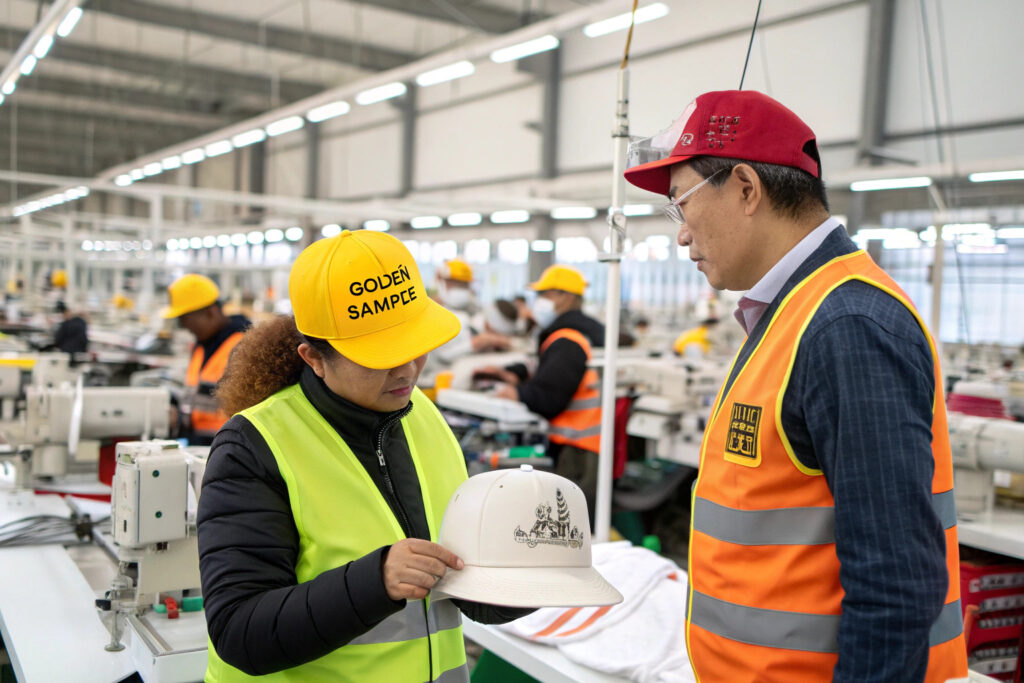
IPQC is a proactive system designed to catch and correct errors in real-time. If a sewing machine's tension is wrong and it's creating a weak seam, an IPQC inspector will spot it after the 5th hat, not the 5,000th. This prevents small mistakes from multiplying into massive problems. These inspectors use the approved "Golden Sample" as their bible, constantly comparing the production units to this perfect standard.
What Are the Key IPQC Checkpoints?
A typical hat production line will have several dedicated IPQC checkpoints:
- Post-Cutting: An inspector checks the cut fabric panels to ensure they are the correct shape and size and have no defects.
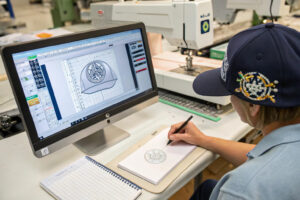
- Post-Embroidery/Printing: The branded panels are checked for logo quality, placement, and color accuracy before they are sewn.
- Post-Panel Assembly: The sewn crown is checked for correct shape, seam strength, and symmetry.
- Post-Brim Attachment: This is a critical checkpoint. The inspector ensures the brim is attached perfectly centered and the stitch line is straight.
- Post-Finishing: After the sweatband and closure are attached, a final in-line check is done before the hat goes to cleaning and pressing.
How Does This System Save Time and Money?
It might seem like all this checking would slow things down, but it does the exact opposite. By catching an error at its source, we only have to fix one small mistake. This prevents the massive waste of materials and labor that occurs when a systemic error is only discovered at the end of the line, forcing thousands of units to be reworked or scrapped. This efficiency is a key reason why reputable Chinese factories can offer competitive pricing without sacrificing quality.
How to finally quality control (FQC)?
This is the final and most formal inspection stage, conducted before the hats are packed into their shipping cartons. The Final Quality Control (FQC) team acts as the ultimate gatekeeper. Their job is to perform a comprehensive inspection on a statistically significant sample of the finished goods to determine if the entire order meets the client's quality standards.
This inspection is conducted based on the internationally recognized AQL (Acceptable Quality Limit) standard. AQL is not a "zero defect" system; it's a statistical model that says, "For an order of this size, we will inspect this many units, and if we find more than 'X' number of defects, the entire order fails the inspection."

How Does AQL Work in Practice?
Let's say you have an order of 20,000 hats. You and the factory agree to an AQL of 2.5 (a common standard for consumer goods).
- Sample Size: Based on the AQL chart, for an order of 20,000, the inspector might need to randomly pull 315 hats for inspection.
- Defect Classification: Defects are classified into three categories:
- Critical: A defect that is hazardous to the user (e.g., a sharp piece of metal, a broken needle in the hat). The acceptable limit for critical defects is always zero.
- Major: A defect that is likely to be noticed by the customer and could cause them to return the product (e.g., incorrect logo, a hole in the fabric, a broken snap).
- Minor: A small imperfection that is unlikely to be noticed by the customer (e.g., a single loose thread, a slightly crooked stitch on the inside).
- Pass/Fail: The AQL 2.5 standard will specify the maximum number of major and minor defects allowed in the 315-unit sample. For example, it might be 14 major defects and 21 minor defects. If the inspector finds 15 major defects, the entire 20,000-unit order fails the inspection.
What Happens If an Order Fails the FQC?
If an order fails, it does not ship. The factory is then responsible for going back through the entire batch to find and fix the identified issues (this is called a 100% re-inspection). After the rework is complete, the FQC team will conduct another AQL inspection. The order will only be packed and shipped once it passes this rigorous final check. This system places the financial responsibility for poor quality squarely on the manufacturer, which is a powerful incentive to get it right the first time.
How to Take the Ultimate Guarantee of Third-Party Verification?
For many large brands and first-time buyers, the ultimate peace of mind comes from hiring their own independent inspection team. A professional Chinese manufacturer will not only allow but will welcome a third-party inspection service (like SGS, Intertek, QIMA, etc.) to come into our factory.
These companies act as your eyes and ears on the ground. They will perform their own unbiased AQL inspection (or whatever standard you specify) and provide you with a detailed report, complete with photos and data, before you ever have to pay the final balance on your order. This is your ultimate insurance policy, and any factory that resists or discourages a third-party inspection should be seen as a major red flag.

Why Use a Third-Party Inspector?
While a good factory has its own robust internal quality control (QC) systems, complete with trained inspectors, standardized checklists, and rigorous testing protocols to ensure products meet baseline standards, a third-party inspector is accountable solely to you, the buyer. This external oversight provides an impartial, objective assessment of your order's quality, free from potential biases or conflicts of interest that might arise if the factory's own QC team were the sole evaluators. For a new buyer navigating unfamiliar supplier relationships, this independent verification can be invaluable in building trust with a new supplier, as it offers concrete evidence that the products meet your specific requirements before they are shipped, reducing the risk of receiving subpar goods.
When Is the Inspection Performed?
The final third-party inspection is typically scheduled when at least 80% of the order is produced and packed, a strategic timing that allows for a comprehensive assessment of the production process's consistency and adherence to quality standards. This ensures that the sample they pull is truly representative of the entire production run, capturing variations that may have emerged during different stages of manufacturing. The factory will provide them with a dedicated space—often a clean, well-lit area within the production facility equipped with necessary tools and documentation—and full cooperation to conduct their audit, including access to production lines, storage areas, and quality control records.
Conclusion
The quality control standards in reputable Chinese hat manufacturing are not a matter of chance; they are a rigorous, multi-stage, and verifiable science. From the moment raw materials arrive (IQC), through every step of the production line (IPQC), and culminating in a statistically-driven final audit (FQC), quality is systematically built in and checked at every turn. The entire process is benchmarked against the approved "Golden Sample" and governed by the international AQL framework. By understanding this system, demanding transparency, and leveraging the option of third-party verification, you can source from China with confidence, knowing that you are partnering with a manufacturer who respects your brand and is committed to delivering excellence on a global scale.
If you are looking for a manufacturing partner who not only meets but exceeds these quality standards, my team at Global-Caps is ready to demonstrate our commitment to quality. Please contact our Business Director, Elaine, at elaine@fumaoclothing.com to discuss how we can bring your project to life with the quality and reliability you deserve.