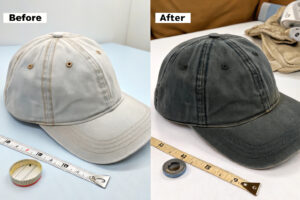
Over my two decades in the hat business, I've designed headwear for almost every imaginable activity: deep-sea fishing, ultra-marathons, even Broadway productions. But last week, I had a meeting that felt like it was pulled straight from a sci-fi movie. A buyer for a new "adventure experience" company—think high-end, adrenaline-fueled tourism—came to us. He wasn't interested in baseball caps or beanies. He put a tablet on my desk, showed me a video of a person flying a jetpack over a canyon, and said, "Elaine, my clients will be doing that. A normal hat would be gone in a second. What can you build for them?"
The best headwear for jetpack flying is not a traditional hat but a fully integrated, low-profile "aero cap" or helmet liner, engineered specifically for high-speed airflow, secure fit, and communication system compatibility. In this environment, a hat ceases to be an accessory and becomes a critical piece of flight equipment, prioritizing aerodynamics and safety above all else.
The problem is obvious and immediate: at speeds of 30-50 mph, any conventional hat, no matter how well it fits, will be ripped from your head by the wind. Furthermore, the activity requires a helmet for safety. This isn't about choosing a style; it's about engineering a solution that works with the primary safety gear. At Shanghai Fumao Clothing, this is the kind of forward-thinking design challenge that our R&D team lives for.
Why Won't Any Normal Hat Work?
You might be thinking, "What about a really tight beanie? Or a snapback cranked to the last notch?" It's a natural first thought, but it fundamentally misunderstands the physics at play. The forces involved in open-air flight are a world away from the wind you experience on the ground.
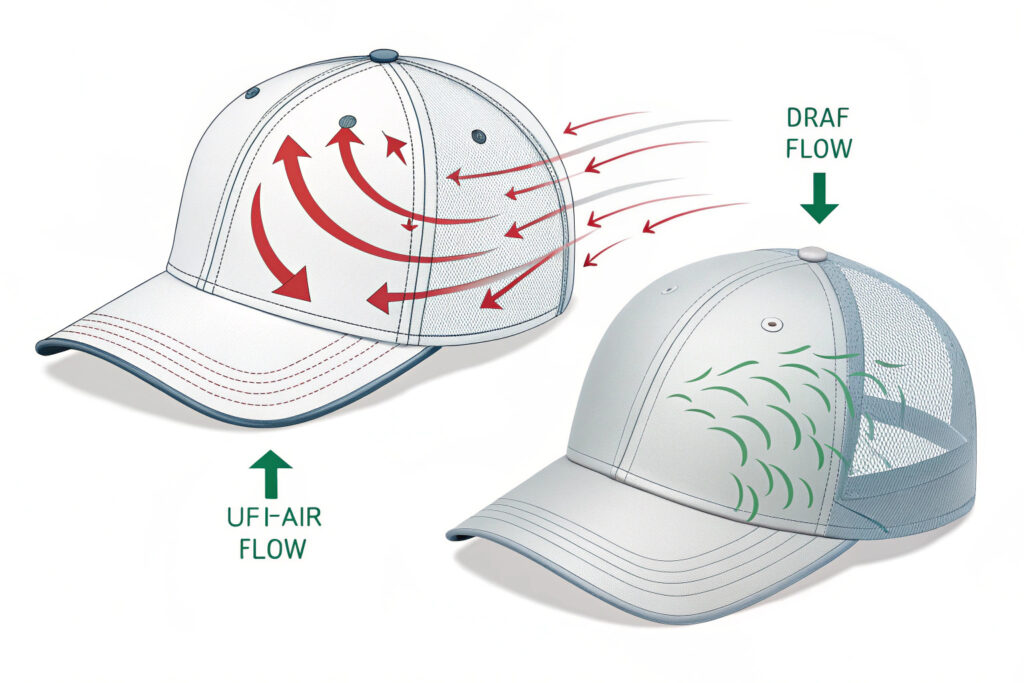
Any normal hat will fail during jetpack flight due to extreme aerodynamic drag and lift. The wind doesn't just push the hat back; it gets under the brim or crown, creating lift—the same force that makes an airplane wing fly—and peels the hat right off the head. It's an issue of fluid dynamics, not just simple friction or fit.
We've seen this on a smaller scale with professional cyclists and speed skaters. They don't wear traditional hats during competition. They wear smooth, aerodynamic helmets or thin skull caps underneath. The principles are the same, just amplified. A Baseball Cap, with its brim acting like a small wing, is the worst possible choice. It would be gone instantly. Even a brimless Beanie, if not perfectly smooth, can catch the wind, vibrate, and work its way off the head.
What are the primary forces at play?
Understanding the forces involved is key to designing a solution.
- Drag: This is the resistance the hat creates against the air. A high-drag hat will pull uncomfortably on your head and neck.
- Lift: This is the force created when air flows faster over the top of a surface than underneath it. The brim of a cap is a perfect lift-generating airfoil.
- Vibration: Inconsistent airflow can cause parts of the hat to flutter or vibrate rapidly, which is not only distracting but can also cause the hat to slowly work its way loose.
Any successful design must minimize all three of these forces.
What about the safety requirement for a helmet?
This is the most important factor and the one that truly defines the design constraints. Any responsible jetpack operator, like the companies pioneering this field such as Gravity Industries, will mandate the use of a certified safety helmet.
This means the "hat" is no longer the primary head covering. It must be a low-profile under-layer, designed to be worn comfortably and safely inside the helmet. This completely changes the design brief from an external accessory to an integrated liner.
The "Aero Cap": A Purpose-Built Helmet Liner
Since a traditional hat is out of the question, the solution is a purpose-built under-helmet layer. We call it an "Aero Cap" or "Flight Liner."
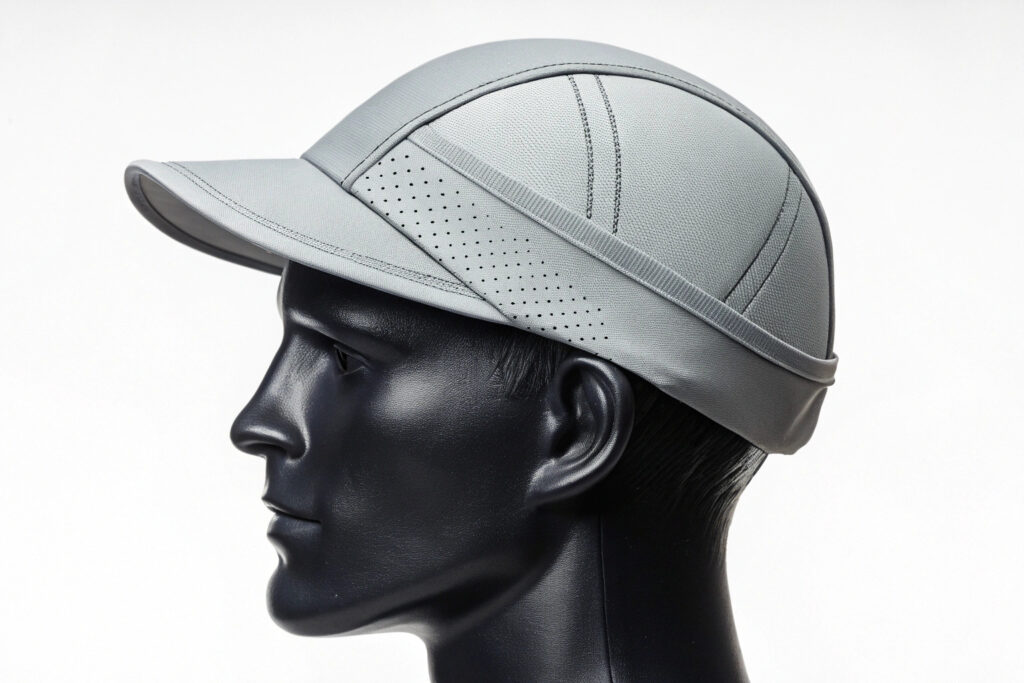
The Aero Cap is a thin, smooth, skull-cap-style liner made from high-performance technical fabrics, designed to manage sweat, improve helmet comfort, and integrate communication systems, all while having zero aerodynamic profile. It's the interface between the pilot's head and their essential safety gear.
The design philosophy here is borrowed from motorsports and aviation. Formula 1 drivers and fighter pilots wear similar liners, called balaclavas, under their helmets. They are designed for fire resistance, sweat management, and comfort during intense, high-G maneuvers. For a recreational activity like jetpack flying, we can adapt this concept, focusing on comfort, cooling, and user experience.
What are the essential material properties?
The choice of fabric is critical for an Aero Cap.
- Moisture-Wicking: The fabric must pull sweat away from the skin to keep the pilot's head dry and prevent sweat from dripping into their eyes. High-performance synthetics are ideal here.
- Smooth Surface: The outer surface must be completely smooth to allow the helmet to slide on easily and not snag on the helmet's inner padding.
- Four-Way Stretch: The fabric needs excellent stretch and recovery to ensure a snug, comfortable, "second-skin" fit for all head shapes.
- Breathability: Even under a helmet, the fabric needs to allow heat and vapor to escape.
How does it integrate with other gear?
A key function of the Aero Cap is to act as a platform for other gear.
- Communications: The cap can have small, flat-stitched pockets or channels over the ears to hold earpieces for communication with an instructor. This is far more comfortable than trying to fit earbuds under a tight helmet.
- Helmet Comfort: It provides a smooth, comfortable layer between the pilot's hair and the helmet's foam padding, preventing chafing and improving overall comfort.
- Hygiene: For a rental or experience-based business, providing each client with a fresh, clean liner is a crucial element of hygiene, much like providing liners for rental ski boots or racing helmets.
The "Sun-Visor Liner": A Hybrid Solution
What about sun protection? A helmet provides impact protection, but its opening can still allow a lot of sun and glare into the pilot's eyes. A standard helmet visor might not be enough, especially when flying into the sun.
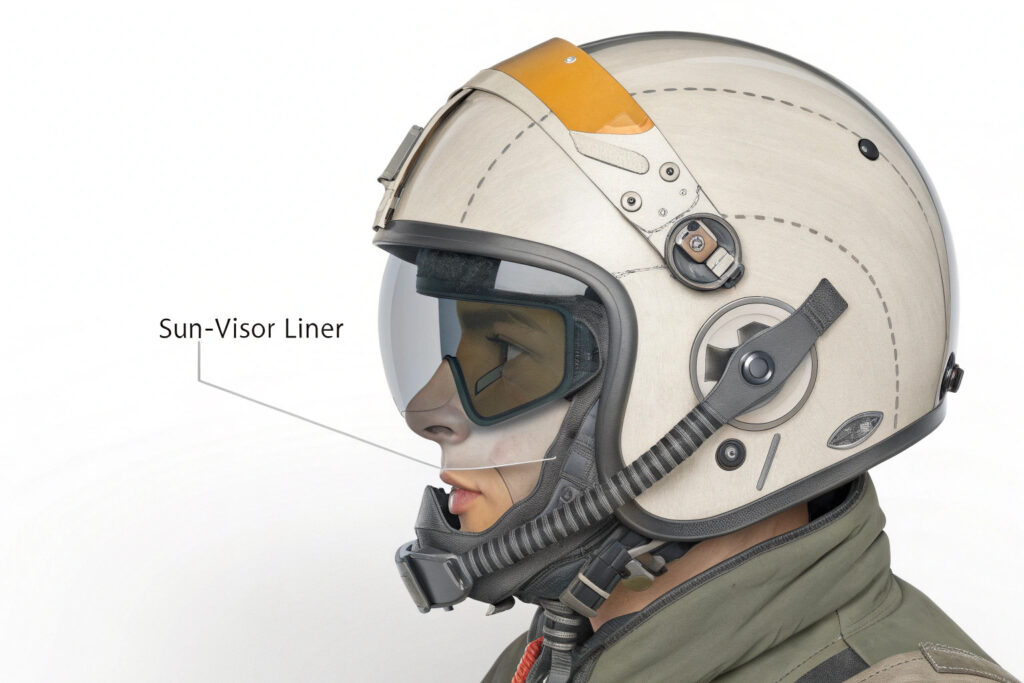
A hybrid solution is the "Sun-Visor Liner," an Aero Cap that incorporates a very short, flexible, and downward-sloping neoprene brim, designed to provide supplemental glare reduction without creating dangerous aerodynamic lift. This is a highly specialized design that bridges the gap between a liner and a hat.
This is where custom manufacturing shines. The brim on this liner cannot be rigid. It must be made of a soft, flexible material like neoprene or laminated fabric that can bend and conform to the inside of the helmet. Its angle is also critical. It must be angled sharply downwards to block high-angle sun without presenting a flat surface to the oncoming wind. It's a feature that requires significant prototyping and wind-tunnel testing, a service we provide for our most technical clients.
What are the design challenges of a brim?
Adding any kind of brim, no matter how small, introduces aerodynamic risk.
- Angle of Attack: The brim must be angled so that the oncoming air pushes it down against the forehead, not up.
- Flexibility: It must be soft enough that it won't create a dangerous pressure point on the forehead in the event of an impact.
- Size: It must be extremely short—no more than an inch or two—to minimize the surface area exposed to the wind.
This is an advanced feature, best suited for lower-speed flights or for instructors who need extra glare protection during a long day of teaching.
Is there a non-integrated alternative?
For sun protection, the primary solution will always be high-quality, UV-blocking sunglasses or a tinted helmet visor, as recommended by aviation safety organizations like the FAA. The Sun-Visor Liner is a supplemental tool, not a primary one. Any non-integrated hat is simply not a safe option.
Conclusion
The question of the best hat for jetpack flying leads to a fascinating engineering problem. The answer is not a hat at all, but a piece of purpose-built flight gear. The low-profile Aero Cap, acting as a sweat-wicking, comfortable, and hygienic helmet liner, is the foundational solution. For an added layer of functionality, a highly specialized Sun-Visor Liner can provide supplemental glare protection. In this exhilarating new world of personal flight, headwear design moves beyond fashion and becomes a critical component of the safety and performance ecosystem. It's a challenge that requires a deep understanding of materials, aerodynamics, and human factors—and it's exactly the kind of future we are excited to build.
If you are developing gear for the next generation of adventure sports and need a manufacturing partner who can create innovative, purpose-built solutions, my team and I are ready to take on the challenge. My name is Elaine, Business Director at Global-Caps, and my email is: elaine@fumaoclothing.com.